



07/08/2026
When I meet with school and district leaders, I receive a lot of questions about AI tools and the best use of AI in education.
While many K–12 leaders are justifiably reluctant to allow AI chatbots to interact with students, there’s growing recognition that teacher-facing AI tools have a lot to offer. When designed well, such tools can help with time-consuming tasks that take teachers away from instruction, from drafting emails to re-leveling text to customizing lessons to meet specific classroom needs.
A colleague phrased this process perfectly during a recent conversation: “The best use of AI in education is helping the teacher, not teaching the student.”
This raises two important questions:
- What do effective AI tools for teachers look like?
- How specifically do such tools help teachers to increase their impact in the classroom?
Benefits and potential drawbacks of AI tools in education
Kurzweil’s Principle isn’t a well-known concept in education, but it’s relevant to our discussion here. Also called the Law of Accelerating Returns, Kurzweil’s Principle states that technology progresses at an exponential rate of growth rather than a linear one. Because each new generation of technology helps to more quickly create the next, the pace of innovation is constantly accelerating.
This is something we’ve all likely felt, and it’s only been magnified as we’ve transitioned to the AI age: constant, unrelenting change. Over the last few years, many district leaders have found themselves rushing to create policies around AI use—all while today’s AI tools are busy building the next generation of AI.
This highlights a key difference between the pre-AI age and this one. With AI, the significant expansion in technological capabilities has raised all sorts of considerations around the appropriate use of technology in schools, given that AI can do things we never dreamed of technology doing before.
For example, we never had to contend with the ethics of “deepfakes,” meaning videos crafted to look and sound like politicians or celebrities and often designed to mislead the public. Now, we must consider—and teach students about—many such things. In this sense, AI is not only providing many answers but also raising entirely new sets of questions.
Clearly, what technology can do and what we should use it to do are two increasingly different things.
Trustworthy AI for schools
See the power of AI tools grounded in decades of learning science and educational best practices.
A commitment to the best use of AI in schools
In an earlier blog, I explained that I find myself grounded amid the disruptions of AI by reconsidering a set of educational principles drafted decades ago by Renaissance’s co-founder, Terry Paul. Along with our mission statement, “To accelerate learning for all,” he also drafted a set of ideas about what teaching and learning should be. These principles remain extremely relevant and continue to encapsulate Renaissance as a company and the beliefs we hold about education.
Through these principles, Terry pledged that Renaissance would only produce things that represent “the best use of technology” in education. This explains why we have avoided programs that assume a dominant role in instruction. We believe that teachers should be at the center of decision making, and that human relationships are at the heart of learning. This is why our mantra is, “Support teachers, don’t supplant them.”
Terry also believed that edtech companies must avoid becoming so enamored with new technologies that they become blind to their potential shortcomings. He insisted that technology should only be used in education when two conditions are met:
- The technology must perform at least as well as, if not better than, a human.
- The technology should not be used in ways that displace necessary aspects of teaching and learning.
AI can obviously provide students with a wide array of answers, from the volume of a cube to the long-term effects of the Civil War. But if, by doing so, AI prevents students from the growth that comes through productive struggle, then it does not represent the “best use” of technology in education and should not be employed in this way.
A point that one prominent company recently learned the hard way.
Khanmigo and the limits of AI teaching tools
Consider the impact, or lack thereof, of Khan Academy’s AI tutor, Khanmigo. Previewed during a TED Talk three years ago, Khanmigo and other AI-based tools were heralded by Sal Khan as “probably the biggest positive transformation that education has ever seen.”
This didn’t prove to be the case.
Dan Meyer recently pointed out that “Khanmigo was raised with a silver spoon in its mouth, possessing advantages completely unknown to most other edtech chatbot startups. It had some of the earliest access to OpenAI’s generative AI technology. It had the backing of a hyperscaler in Microsoft and abundant cloud computing credits. It had the endorsement of national, state, and local officials. It had the phone number of some of the wealthiest people in the world.”
And yet, in Meyer’s words, Khanmigo “died in spite of those advantages” in the sense that, rather than being front and center in any Khan Academy experience today, it’s now relegated to being a mere icon on a sidebar.
Dr. Dave Maddock, my colleague at Renaissance, was in a district that worked with Khan Academy as some of the first Khanmigo users. Maddock told me that Khanmigo offered some benefits, particularly for students who didn’t understand a question due to unfamiliar or complex vocabulary. However, “when we started looking through the usage, we always noticed the same issue: kids don’t really ask good questions,” he told me. “It was a bunch of, ‘Can you make this easier to read?’ or ‘I need this in Spanish.’ Not the strong, probing kinds of questions that teachers and tutors actually provide.”
Maddock added that Khanmigo ultimately “wasn’t really a tutor but just a chatbot,” given that it “required students to understand their own misunderstanding” in order to prompt it properly. He concluded with this statement:
That’s sort of the problem with most AIs, isn’t it? They’re built to take the easiest (meaning the cheapest, token-wise) route to the answer. For students, this means basically giving them the answer immediately. Tutoring as a skill is all about probing for misunderstanding, continually pushing against abstract variables (time taken to respond, half- and miscues, facial response to questioning) to modulate the proximal difficulty of the question to the point where the student enters a productive zone.
In short, Khanmigo withered because it couldn’t perform the task of tutoring as well as or better than a human. In its current form, AI isn’t able to fully understand and respond to students’ needs. For this reason, and seen through the lens of our Renaissance principles, developing AI tutors doesn’t represent “the best use of technology” in education. And we’re clearly not alone in holding this view.
The enduring role of teachers in the age of AI
So, what role should AI play in K–12 schools? A recent report from Ed3 titled The Emerging Role of Teachers in the Age of AI provides helpful insights.
The report notes that the majority of educators do not believe that AI tutors and adaptive digital tools should be “the primary mechanism for delivering [instruction in] core subjects.” Educators’ concerns in this area “relate to academic integrity, misinformation, bias, and student privacy, while fears about job displacement or cost are less prominent,” the authors explain. This signals “a focus on safeguarding learners and maintaining trust, rather than resistance to AI adoption” per se, they add.
In fact, “scenarios that expand, redesign, or diversify teacher roles, or that increase authenticity and relevance of learning, receive substantially stronger support,” they write. Teachers are, in other words, very open to using AI as a tool to help them with curriculum design, instruction, and assessment/evaluation.
These points echo my earlier contention that AI is best suited to helping teachers, not teaching students. This is why our new Renaissance Intelligence system is focused on using AI-based functionalities to support teachers’ daily work rather than attempting to fully take over instruction.
What does this look like in practice?
Renaissance Intelligence: Human-centered AI tools for teachers
Within Renaissance Intelligence, the AI-powered Learning Engine uses data from both assessments and ongoing practice to gauge each student’s performance level. The tool then combines this with our deep understanding of state standards and individual skills drawn from decades of work around learning progressions. The result? Students in each class are grouped so teachers can see:
- Who needs work with core concepts.
- Who needs support with prerequisites.
- Who is on an enrichment pathway.
With skills and groups identified, the AI-powered Alignment Engine then takes over. Its job is to survey a massive collection of learning resources from both Renaissance and our core publisher partners to make suggestions about which resources would best support the students in each group, while maintaining alignment with core curriculum.
As my colleague Dr. Maddock points out, this is work that has never been possible in the classroom before at this scale. The work of collecting, connecting, and analyzing every assessment, practice question, knowledge check, and exit ticket to create a holistic picture of student understanding—one deeply connected to both curriculum and standards—has typically been the work of “data dig” events or large-scale research.
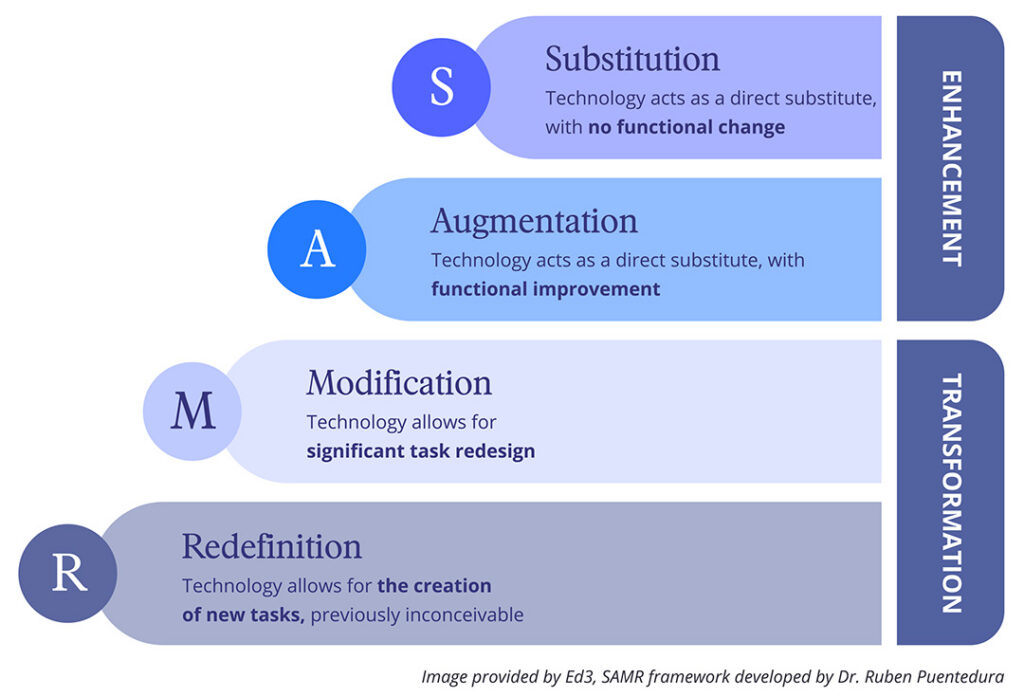
For this to happen every time a teacher looks at their screen truly redefines what it means to “use data” in the classroom. As Dr. Ruben Puentedura highlights with his SAMR Model (shown below), AI that augments what a teacher does can, at most, enhance their current practice. True transformation requires more than just the transactional use of AI, to allow not only for task redesign but also for the creation of new tasks, previously inconceivable. And this is what Renaissance Intelligence ultimately provides:
This point takes us back to Terry Paul and our commitment to the best use of technology in education. It also raises the question of how Renaissance defines itself as an organization. Are we a technology company that dabbles in education, or are we an education company that uses technology to support teaching and learning?
As the Khanmigo example illustrates, some organizations struggle to strike the right balance. But as another Renaissance colleague recently remarked, Renaissance Intelligence shows that we’re closer to the mark, using AI not to displace teachers but rather to amplify their expertise, so they can make the best use of every instructional minute.
Learn more
Connect with an expert to see how Renaissance Intelligence can help to increase your teachers’ impact in the year ahead.