


What is reading comprehension?
While the definition of reading comprehension might sound straightforward, the journey to building strong reading comprehension skills is quite complex and dynamic.
Reading comprehension is the ability to understand oral and written text by constructing meaning from words and ideas and making sense of it in a mental model. It is a fundamental cornerstone of literacy and the Science of Reading (SoR).
In 1986, Philip Gough and William Tunmer proposed that The Simple View of Reading was quite … well, simple: reading comprehension was the product of decoding and language comprehension.
D x LC = RC
Yet this simplistic view doesn’t quite capture the dynamic engagement that needs to take place between the reader and the symbols, words, and sentences. Reading comprehension is an active process where readers are trying to make sense of written text by wrapping their understanding in one’s personal prior knowledge as well. An individual’s level of vocabulary acquisition as well as their lived experiences and background knowledge affect how they use critical thinking skills to make sense of what they read.
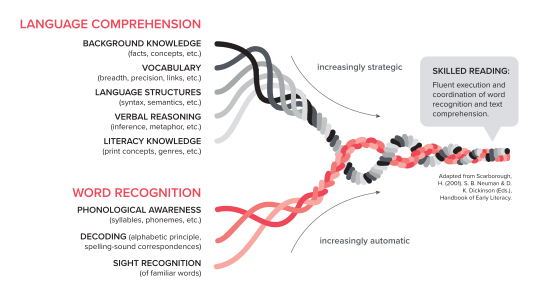
A few years later in the 1990s, Dr. Hollis Scarborough shared her visual model of reading comprehension, Scarborough’s reading rope, that similarly focused on word recognition and language comprehension but illustrated the multiple strands of skills that must intertwine. This “reading rope” underscores the interconnectedness of skills and exemplifies how if one strand is weak or loose, the whole model can be affected.
What are the different levels of reading comprehension?
While the levels of reading comprehension can vary—some claiming four while others claim five—most agree that there are three core tiers to consider: literal, inferential, and evaluative (or critical):
- Literal comprehension is the ability to understand what the text says. These lower-level comprehension skills involve recalling details and facts or comprehending the sequence of events. Educators often rely on the 5Ws to ask who, what, where, when, and why.
- Inferential comprehension focuses on what the text means. Students might need to “read between the lines” by making inferences or predictions that aren’t explicitly stated. They often are asked to draw conclusions citing evidence from the text or from their own personal experiences.
- Evaluative comprehension requires higher-order thinking skills about what the text is worth. Students evaluate the passage as a whole to think critically about an author’s purpose and to analyze, critique, and form judgements about what they’ve read.
Reading comprehension resources
Looking for more recommendations for best practices and supporting reading comprehension strategies? Check out these additional resources:
- Blog: The top proven reading comprehension strategies for educators
- Blog: 7 essential elements of early literacy for developing successful young readers
- Renaissance Literacy: One workflow for stronger instruction
- Solutions for developing early readers
- 10 Instructional strategies to teach reading comprehension
- How to decode the Science of Reading