


The Federal Funding for Elementary and Secondary Schools brochure provides a brief overview of each Renaissance product and the individual funding streams to which they align, plus information on relevant professional learning to support effective implementation.

Pre-K–12 Education Funding Resources
Find funding that can be used to purchase Renaissance products.
Federal funding for elementary and secondary schools
The Every Student Succeeds Act (ESSA) provides both formula funds and competitive grants. These federal funds provide billions of dollars for education programs each year that districts use to supplement state and local funding.
Renaissance products qualify for purchase under a variety of federal K–12 education funding streams, as well as federal funding for preschool, to support student learning and growth in any environment.
The Federal Funding At-a-Glance matrix includes a snapshot of the products most closely aligned to each federal funding stream.
Federal funding basics and updates for school leaders
Blog
Federal education funding explained: What K–12 leaders need to know
Learn how federal education funding flows from the federal government to states and districts, the difference between formula funds and competitive grants, and how federal funding levels affect school budgets for the 2026-2027 school year. Get answers to frequently asked questions and more from our Government Affairs team.
Video
What districts need to know about the timing of federal education funding
Darice Keating, Renaissance Senior Vice President of Government Affairs, provides an update on what districts need to know about the timing of Fiscal Year 2026.* Federal Education Funding, including what you need to know for the 2026–2027 school year.
* Fiscal Year 2026 (FY26) for the U.S. Federal Government runs from October 1, 2025, through September 30, 2026
New US DOE rule for Competitive Grants includes AI priorities
Effective May 13, 2026, a new rule for the US Department of Education’s discretionary grant programs prioritizes applications for projects that include one or more Artificial Intelligence (AI) priorities. These priorities include, but are not limited to, the use of AI to support early intervention, integration of AI-driven tools into classrooms for personalized learning, or use of AI technologies that promote efficiency in the classroom by reducing time-intensive administrative tasks. Applicants vary by the competitive grant opportunity but can include state departments of education, local education agencies, consortia of agencies, etc.
About our products
Renaissance Intelligence
Renaissance Intelligence unifies assessment, instruction, and practice in one system with powerful AI that responds to student performance in real time and turns trusted insights into immediate guidance at scale.

Renaissance Ecosystem
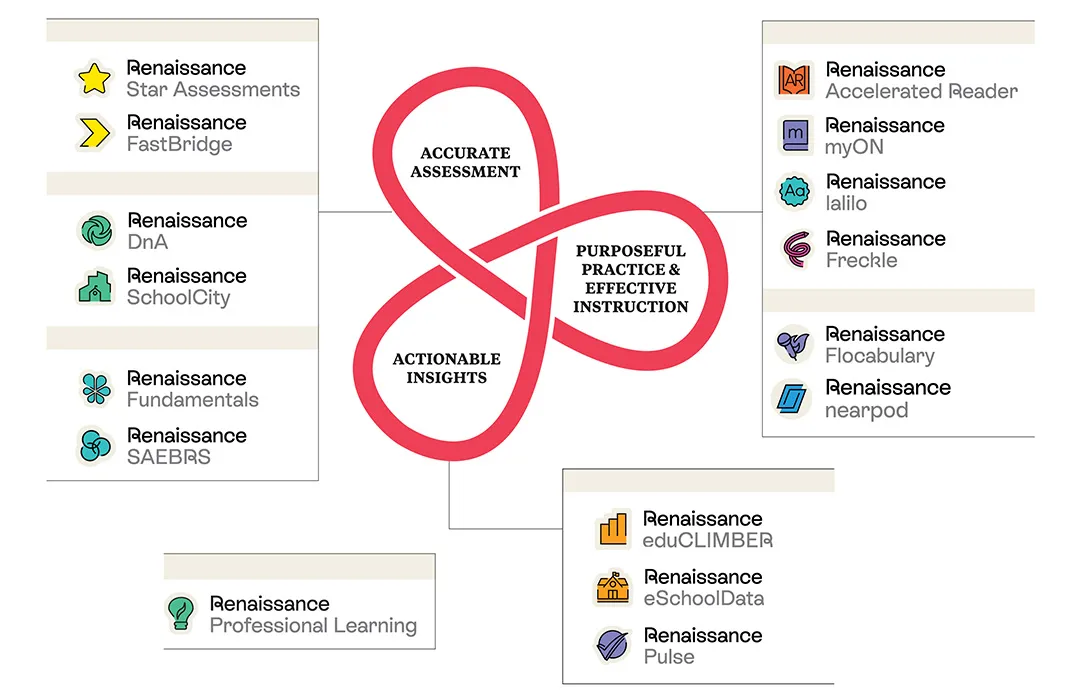
The interconnected products within the Renaissance Ecosystem accurately assess learning and growth, provide purposeful practice and effective instruction, and support a whole child approach to data-informed decisions.
About Federal Education Funds
Formula Funds
Formula funds are allocated annually to state education agencies or directly to school districts based on the number of students meeting specific eligibility criteria.
Competitive Grants
Competitive grants are awarded through a selection process. They are typically multi-year, and the dollar amounts are usually significant. The applications require compelling data to support the need, precise plans for the proposed program, and rigorous attention to detail.
Did your state receive a Comprehensive Literacy State Development Grant?
Learn more about these grants and how the Renaissance literacy portfolio of pre-K–12 products offers districts a comprehensive approach to meeting their state’s CLSD goals.

Funding resources guide
Finding state and local opportunities—and writing an effective proposal for school funding—can be a challenge. Your Guide to Securing Funds to Accelerate Student Learning provides tips and resources on how best to approach funders and get the most from your efforts. What you’ll find in the guide:
- Preparing a proposal to your administration
- Tips for making a phone call to a foundation
- Tips for working with a grant writer
- Writing successful foundation and corporate grant proposals
- Finding funds in your own backyard
- Grant-writing dictionary
Funding your summer learning program
Federal, state, and local funds can help you implement Renaissance products and solutions that boost learning during summer and throughout the school year.
Other frequently-used funding options
Budgeted funds
Many of our customers use dollars already budgeted within their districts to purchase Renaissance solutions. These include allocations for assessments, instructional materials, library collections, technology, professional learning, and contributions by district foundations and parent organizations.
The best strategy for accessing these funds is to include the cost of your Renaissance programs when administrators prepare yearly budgets. If a formal proposal to an administrator is required, we can help.
Foundation and corporate funds
Foundation and corporate support for education is often focused on specific areas of interest, such as literacy, STEM, elementary education, or particular student populations.
Foundations may award grants nationwide, within a specific state, or only in designated regions or communities. Corporations usually offer grants in locations in which their employees or customers live or work.