



Published: Oct 26, 2026
For decades, a key debate in K–12 education has focused on testing time and whether shorter, more efficient tests like Renaissance’s Star Assessments deliver the reliable data that educators need. In this blog, I’ll share the latest developments in this debate, which is—perhaps surprisingly—drawing to a close.
I’ll also discuss what I believe to be the future of student assessment and data-driven decision making in schools.
A commitment to shorter, more efficient assessments
I first encountered Star Assessments as a young teacher in the 1990s, when we brought Star Reading to our school. It proved immediately useful. Within minutes, we could test students and get a variety of norm- and criterion-referenced scores.
I remember sharing the dynamics of Star with some colleagues. At that time, the assessment included 25 questions, all of which were vocabulary in context. Students generally completed the test within 15 minutes. One colleague immediately remarked, “There’s no way such a short test can produce reliable information.”
To that end, she proposed an evaluation of Star’s reliability. This particular teacher supported special education and intervention students. She had just administered a much longer standardized test to her students, and she was eager to compare the results. A few days later, she walked into my classroom and said, “I can’t believe it, but Star nailed it. The results lined right up with the results I got from the other test. And it was so fast!”
Given the number of assessments in schools today, it might be hard to imagine the landscape of the mid-1990s, when most teachers—save a few special education colleagues—did not have access to any norm-referenced test to use regularly with their students.
Star offered something very different.
A decade later, I was in the room when Renaissance’s co-founder and CEO, Terry Paul, approved the expansion of Star Assessments from their original versions to today’s slightly longer versions capable of screening, progress monitoring, and instructional planning assistance.
I vividly remember that Terry stressed to the group how, if we didn’t get things right, we could easily compromise what teachers appreciated most about Star: its efficiency. While he understood that the tests would need to be slightly longer in order to support additional functionalities, he was also very concerned about not making them too long to meet teachers’ and students’ needs.
Understanding an assessment’s value—and cost
In an earlier blog, I discussed a simple but powerful formula that Renaissance has used for decades to capture our assessment design objectives. This formula helps us address Terry’s concern:
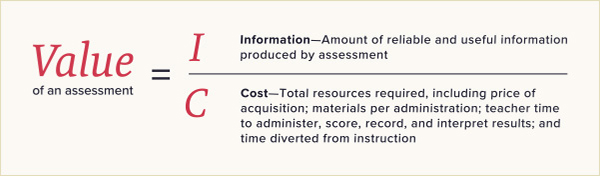
The formula states that the value (V) of an assessment must be measured against the information it provides (I), in consideration of the cost involved (C). Here, cost refers not only to the literal cost of purchasing the assessment but also to the time and effort needed to administer and score it, including the time taken away from instruction.
For years, our tests have been the shortest, most efficient options among the leading providers. Sales pitches and promotional literature from our chief competitors cautioned educators to be wary of shorter tests, claiming they could not be equally reliable. This is despite:
- Our transparency in releasing technical documentation.
- Star’s ability to produce highly reliable scores, as independently validated by the National Center on Intensive Intervention.
Well, as the old adage goes, “Imitation is the sincerest form of flattery.” We are indeed flattered that our two major competitors, Curriculum Associates and NWEA, have both recently revised and shortened their tests. For years, it seemed they failed to understand the V=I/C formula; in fact, their former customers consistently told us, “The tests were just so long.”
What these educators were really saying is, “We just didn’t feel like we got value back for the time we put in.” This brings us to a second important consideration.
From assessment data to instructional next steps
Along with testing time, there is another common debate around interim assessments: How well they answer the question, “What’s next?” When teachers are told things like “these students are behind” or “these students are ready for a challenge,” they very logically ask, “Do you have something to help with that?”
Answering “Yes” is a powerful way that value is added to the assessment process. And in the same way that Renaissance led the charge for the shortest possible assessments with high levels of reliability, we are now leading the way in showing teachers exactly what’s next for their students.
#1: Identifying the next skills for instruction
Most assessments produce a valid but rather generic instructional planning report. As the name implies, the report lists the skills within the current range of a student, group, or class that a teacher could address next.
The problem is that, when making these recommendations, most assessments are missing a critical piece of information: which textbook the teacher uses.
We’ve recently added to our Star Assessments the ability for users to indicate not only which textbook they’re using but also which unit they’re teaching. This allows our systems to fundamentally reframe recommendations. Instead of broad instructional planning recommendations listing all skills within range across multiple domains, our systems instead focus on the skills most relevant to the current grade-level topic.
Consider the example of a grade 3 teacher using enVision+® Mathematics 2024 and focusing on Topic 1, Understand Multiplication and Division of Whole Numbers. Once she has indicated that this is the unit of instruction, Star immediately places her students into three suggested groups: Core Concepts, Prerequisite Skills Plan, and Enrichment Pathway:
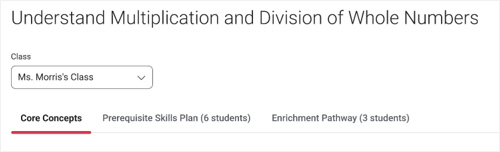
For the Core Concepts and Enrichment Pathway groups, the skills recommended are not generic but rather the skills of the current unit—with the helpful identification for the teacher of which students are ready to learn the core concepts and which will likely be ready for enrichment.
For the Prerequisite Skills Plan group, the teacher is shown which students likely need review and reteaching. Rather than having to do the “backwards mapping” herself to identify the prerequisite skills from earlier in the year or from earlier grade levels that support the current unit, these are automatically identified:
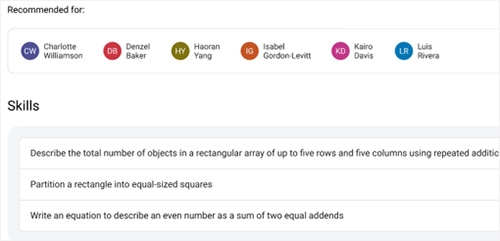
This approach is based on the current pedagogical conversations encouraging consideration of both instructional coherence and accelerated learning.
#2: Providing aligned instructional resources
The second part of the answer to “What’s next?” involves instructional resources for each of the recommended skills. This is another area in which Renaissance is leading the industry in producing assessments of a higher value to schools. We’ve done this through both acquisitions and partnerships.
Through the acquisition of programs such as Lalilo and Freckle, we can connect assessment results to targeted practice opportunities. The addition of Nearpod to the Renaissance family not only brought thousands of lessons and activities into our ecosystem, but also a dynamic platform for delivering those lessons and engaging students in teacher-led instruction.
It’s critical to highlight one more element that differentiates Renaissance: Our willingness to partner with other providers. Even the most cursory pass through the Publishers section of the Nearpod Library reveals an extensive list of content partners.
Within this list you’ll find companies that sell their own assessments and practice products that compete with ours, but we welcome the value their content brings to our customers. The spirit of this is captured in a phrase that we often use when discussing partnerships: “We believe that kids learn better when we all work together.”
And partnering has taken a new form with our Core Publisher Program. Through formal agreements with curriculum providers such as Savvas Learning Company, McGraw Hill, Eureka Math2, and others, we can display both our own resources and resources from the textbook provider to teachers. These connections bring additional value and functionality to our products and those of the partners.
New partners are continuing to join the program as well. This stands in stark contrast to one chief competitor, with no partners. Their assessment connects to their curriculum only. Another chief competitor does partner with others, but on a very limited scale. It’s no stretch to say that Renaissance assessments connect to more resources from more providers than any similar products on the market.
Connecting assessment, instruction, and core curriculum
What’s exciting about these expanded answers to “What’s next?” is how, without taking more assessment time, they bring more value to our assessments for schools. Think back to the formula I mentioned earlier, V=I/C. More information for teachers—in terms of skills to target and curriculum-aligned resources to use—results in even more value, at no additional cost.
The much younger me who was introduced to Star Assessments in the 1990s could not have imagined what the future held:
- How I’d go on to work with educators around the world in their use of Star
- How Star would expand to include curriculum-based measurement for reading and math
- How authentic Spanish versions of Star would be developed
- How Star would be used to support dyslexia screening, measure student growth, and chart progress toward biliteracy
- How Star would power our new Renaissance Intelligence system, bringing together assessment, teacher-led instruction, and targeted and adaptive student practice
While additional versions, functionalities, and connections have been added, the core element of Star has remained constant. Its value is still best measured by weighing the information it provides in consideration of the cost, both in time and resources.
Sadly, Terry Paul didn’t live to see what Star has become. But I think he’d be very proud that we remain committed to ensuring that Star remains an efficient and highly informative assessment for schools.
I also know that he’d be flattered by how—after years of failing to understand the V=I/C formula—our chief competitors are now following our lead and shortening their tests. Because the most expensive assessment for a school is the one that teachers won’t use, because the value of the information they receive isn’t worth the amount of time required to get it.
I suspect that our competitors will continue to follow our lead by creating their own textbook alignments and bringing connected instructional resources into their assessment products. Here, again, imitation truly is the sincerest form of flattery.
Learn more
Connect with an expert to see how Star Assessments help to turn data into instructional action in every classroom.