Fundamentals is a universal student attitudes screener for pre-K–12 that uncovers non-academic barriers to learning. Students complete a brief, research-based survey that reveals insights into motivation, belonging, confidence, and overall readiness to learn—helping districts strengthen school climate, Tier 1 supports, and whole child initiatives.
Uncover student attitudes that influence learning
Proactively identify and address non-academic barriers to student learning and success.

Praise for Fundamentals
Renaissance Fundamentals gives us a way to bring the parents into the conversation more easily, creating a partnership approach that further helps students.
Identify at-risk students experiencing low engagement, confidence, or motivation
Meet Renaissance Fundamentals [2:30]
Pre-k–12 universal screener
Reliable, research-backed measures of student attitudes
Fundamentals is a key part of your MTSS or whole child strategy, helping educators identify students at risk early. Dynamic, instant reports provide district-to-student-level insights across nine attitudinal factors that reveal how students feel about school and themselves as learners.
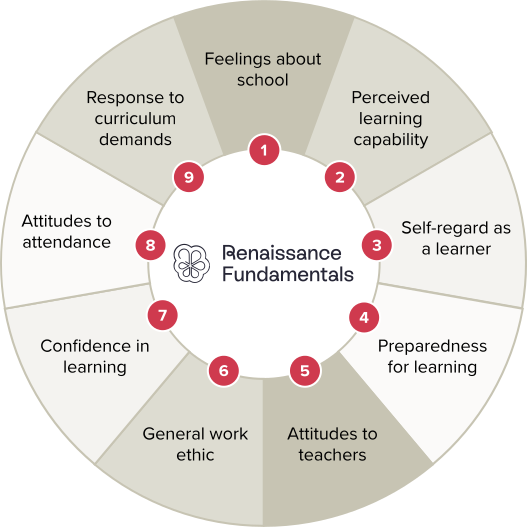
Renaissance Fundamentals provides a standardized measure for these nine factors
-
Feelings about school
Measure a student’s sense of wellbeing, safety, and comfort in school.
-
Perceived learning capability
Measures students’ views of how positive and successful they feel in their specific capabilities as learners.
-
Self-regard as a learner
Measures the impact of students’ learning on their concept of self, generally.
-
Preparedness for learning
Measures students’ perceptions of their behavior and attitude in learning situations (including metacognitive skills).
-
Attitudes to teachers
Measures students’ perceptions of their relationships with teachers.
-
General work ethic
Measures students’ attitudes and responses to work in general.
-
Confidence in learning
Measures students’ confidence in approaching and dealing with learning and perseverance when presented with challenging tasks and includes associated feelings such as a high anxiety element.
-
Attitudes to attendance
Measures students’ attitudes to attendance at school.
-
Response to curriculum demands
Measures students’ perceptions of the appropriateness of the level of difficulty of work they are asked to complete.
Renaissance Fundamentals for grades pre-K–12 is focused on and offers insights into just four factors, adapting to meet the unique needs of these grades.
A Roadmap to stronger supports
How Fundamentals works
1
Survey
Students take a brief Fundamentals survey.
2
Analysis
Educators review clear, easy-to-read reports to analyze the survey results.
3
Intervention
Educators put targeted interventions in place, guided by insights.
4
Retake
Students retake the survey to show changes over time.
5
Results
Educators view side-by-side results to see growth at a glance.
Inspiring action at every level
The right insights for every role
Fundamentals provides clear, actionable attitudinal data to help administrators, MTSS teams, counselors, and teachers strengthen student engagement, improve school climate, and support whole child decision-making.
Lead with whole child insight
Administrators use Fundamentals to:
- Identify areas of success or concern
- Prioritize schoolwide supports and allocate resources
- Evaluate and refine SEL programs
- Strengthen MTSS programs using whole child data
- Ensure equity across student groups
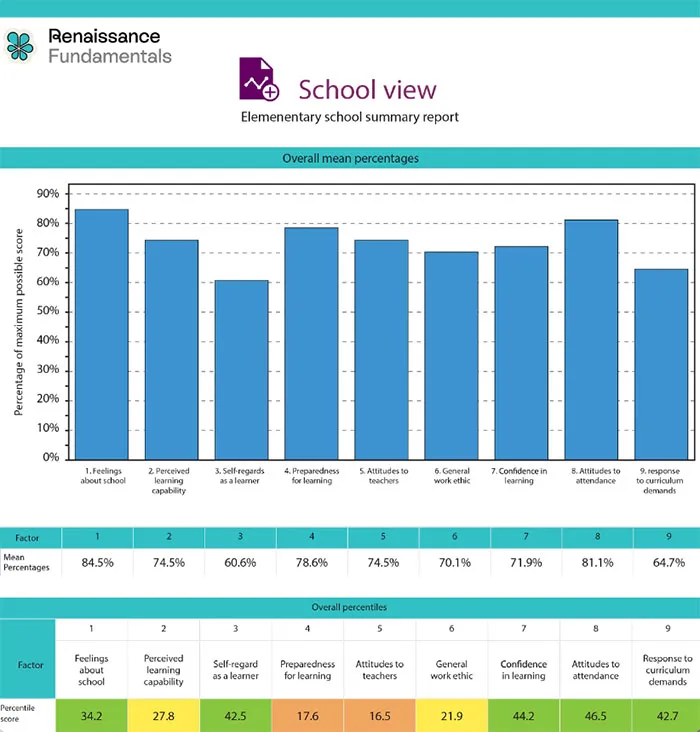
School view in Renaissance Fundamentals
Strengthen Tier 1 supports
MTSS teams rely on Fundamentals to:
- Detect early signs of disengagement across grades and cohorts
- Inform Tier 1 instruction and guide Tier 2 and Tier 3 interventions
- Understand attitudes that may impact academic performance
- Monitor whether initiatives improve student attitudes over time
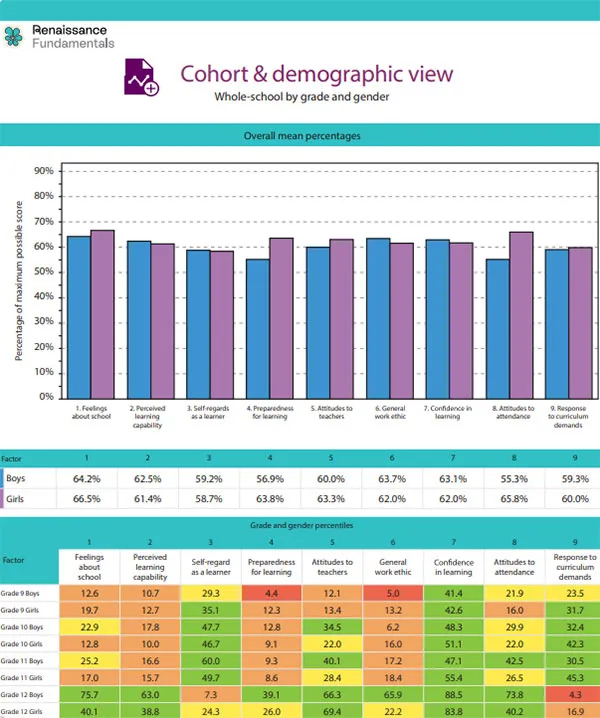
Cohort and demographic view in Renaissance Fundamentals
Get insights into every learner
Teachers and counselors use Fundamentals to:
- Identify students needing targeted one-to-one support
- Group students with similar needs for intervention
- Spot students who might otherwise fall through the cracks
- Share student insights with families
- Measure the impact of interventions over time
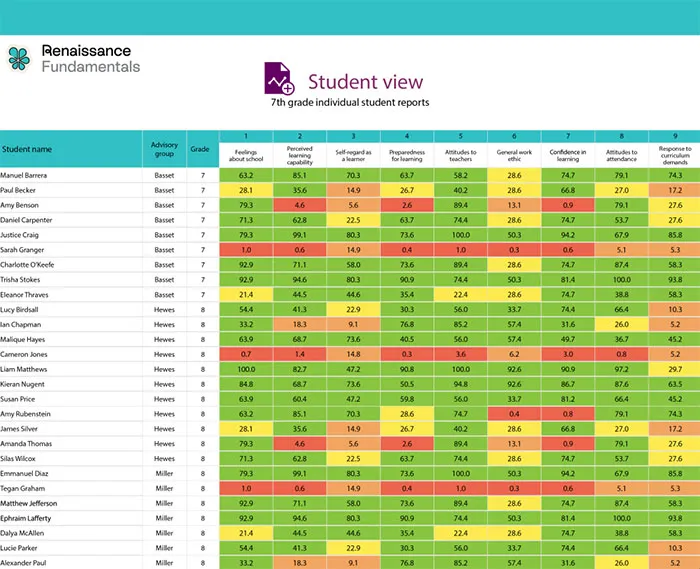
Teachers view in Renaissance Fundamentals
Give students a voice
Fundamentals empowers students by giving them:
- A safe way to share feelings about school and learning
- A chance to articulate confidence, worry, motivation, and belonging
- Greater ownership in conversations about their success
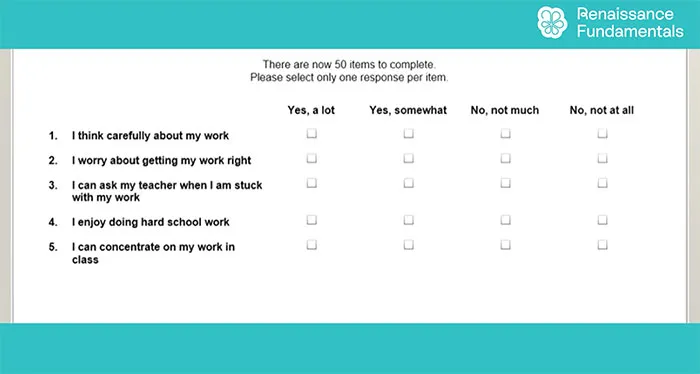
Student survey
A streamlined MTSS solution for data-driven school improvement
With assessments, instruction, and analytics in one connected ecosystem, your team can confidently implement MTSS. Access real-time whole child data, collaborate efficiently with smart workflow tools, and make equity-focused decisions that accelerate learning.
South Fayette Township School District
Tailoring support to students who need it the most
See how South Fayette Township School District utilizes Renaissance Fundamentals as a universal screener to uncover students at risk and strengthen whole child supports.

Recognized for excellence
Celebrating Fundamentals’ impact
Fundamentals continues to earn industry recognition for its positive impact on learning outcomes.
Funding is available for Fundamentals
From federal and state funds to corporate grants, learn more about resources that can help with the purchase of Fundamentals.
Expand your MTSS toolkit
Get the most out of Fundamentals
Learn how Fundamentals supports MTSS and whole child initiatives.

Research
Fundamentals post-COVID standardization
Explore the reliability and validity behind Fundamentals.

Guide
Take a proactive approach to attendance
Discover strategies to raise attendance levels in your school.
Brochure
Renaissance Fundamentals CASEL alignment
See how Fundamentals’ nine attitudinal factors align with the CASEL 5 core competencies.
Your questions answered
How Fundamentals strengthens whole child support
Explore common questions about how Fundamentals uncovers barriers to student learning, elevates student voice, and delivers actionable attitudinal insights to guide SEL, MTSS Tier 1 supports, and school-climate improvement.
Want to learn more?