

Union County Public Schools
North Carolina
Nestled just outside Charlotte, Union County Public Schools (UCPS) is a large suburban district serving about 40,000 students across 53 schools—including 9 middle schools, 11 high schools, and 30 elementary schools.
Like so many districts, Union County Public Schools (UCPS) in North Carolina is no stranger to “doing more with less.” However, despite ever-present funding challenges, the district is proving that it’s possible to achieve large-scale gains in student success through the thoughtful and strategic use of resources.
The district, the sixth largest in the state, has achieved impressive double-digit growth in middle school math through a comprehensive approach that includes a daily, in-school, high-dosage tutoring model; effective, tier-one instruction; and the implementation of Star Math and Freckle from Renaissance. The district’s efforts to align these tools to clear, consistent expectations for use, meaningful professional development, and data-driven practices have maximized their impact.
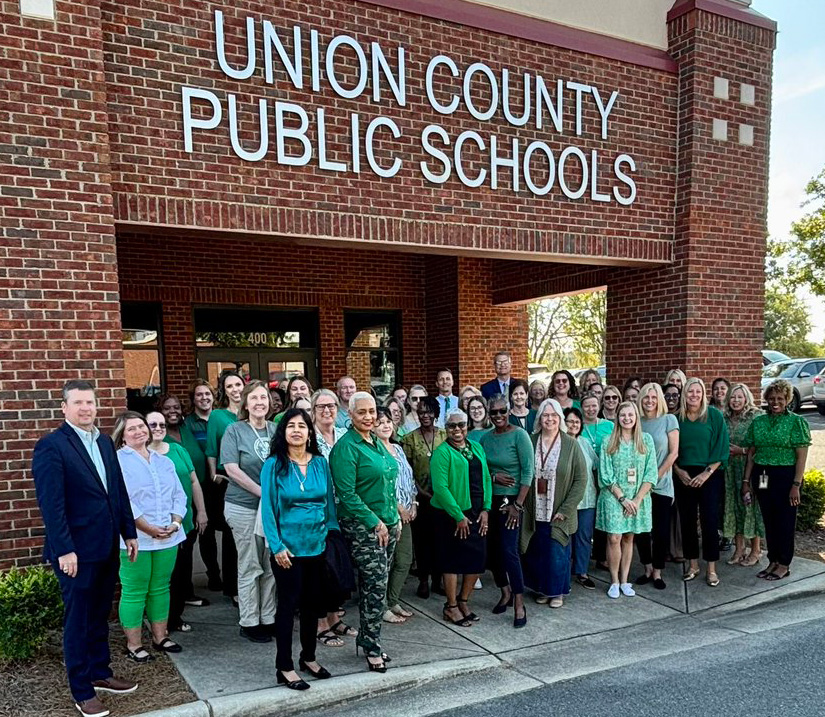
Photo credit: Union County Public Schools (via official Instagram)
Aligning critical pieces of product integration
“UCPS has clearly demonstrated what can be achieved when we align key strategies and utilize effective tools and resources,” said Dr. Andrew G. Houlihan, Superintendent of UCPS. “We value our partnership with Renaissance and look forward to sustaining this model for years to come.
Casey Rimmer, Executive Director of Curriculum and Instruction, oversees curriculum, professional development, and educational technology at UCPS. In her role, she strives to ensure that all three work in synergy to create successful student outcomes.
“You can’t have a successful implementation without curriculum, professional development, and edtech working together,” she said. “That’s been the magic sauce for us. We didn’t ask, ‘How do we use Renaissance products?’ We asked, ‘How do we change math instruction for the better—and how can these tools help us do that?’”
Streamlining tool efficiency to improve student outcomes
The first necessary step, the district decided, was to pare down its many existing math products used for screening and practice. None of them worked together, making it difficult for educators to get a holistic view of math performance at every level.
Each school was kind of doing their own thing when it came to math diagnostics and practice. Everyone had bought different programs, and when the superintendent asked, ‘How’s math going?’ Every principal had a different answer. We saw a disconnect.
— Casey Rimmer, Executive Director of Curriculum and Instruction
The district’s efforts to streamline math tools began with a two-year pilot of Star Math and Freckle in four middle schools—intentionally chosen as middle-of-the-road schools, neither the highest nor lowest performers.
“Our high-performing schools already had a lot of resources,” Rimmer explained. “Our low-performing schools had extra support and Title I funds. But our middle-of-the-road schools often didn’t have either. They were the perfect place to start.”
Redefining the math block with Freckle and Star
The district also hoped to move away from one-size-fits-all instruction toward data-informed, small-group learning. Teachers also began incorporating goal setting and reflection into their routine.
Star Math assessments gave district leaders the ability to track data across schools and measure school performance. Teachers received data to help them understand where individuals and groups of students were at and plan instruction targeted to their areas of need.
“Talking with students about what their Star scores mean and setting goals was huge,” Rimmer said. “It gave students ownership and teachers clarity.”
Once teachers identified the skills students needed to learn, Freckle became a central component of the instructional block. Teachers could assign whole-class, small-group, or individual assignments to target these specific skills. With Freckle’s adaptive practice, students could work at a pace that worked best for them.
“To make small-group instruction work, you need the rest of the class engaged in meaningful practice,” Rimmer said. “Freckle became that huge component of the instructional block. In schools where expectations were clear—when and how often students used Freckle—we saw the most growth.”
Proving product potential and gaining buy-in
The district paired each of these products with professional learning to ensure school leaders and teachers understood how to use them to their full potential. Throughout the pilot, teacher leads participated in learning sessions every six weeks, combining Renaissance training with collaborative planning for PLCs and classes.
Additionally, the district made efforts to:
- Set clear expectations. District leaders found that success came when schools established clear expectations for how often and when products were utilized.
- Gather teacher feedback. When teachers shared their experiences and offered best practices, others understood not only how and when to use the products, but why.
- Guide data-driven decisions. Both teachers and students learned to interpret data and set learning goals to deepen engagement with each product, driving accountability in PLCs and motivating students to take ownership of their math learning.
Rimmer notes that principals who prioritized and utilized Renaissance data (and passed that importance on to PLCs) saw the strongest results from the pilot. Dr. Brian Patience, for example, was principal at Porter Ridge Middle School during the pilot and moved to a lower-performing middle school, Sun Valley, in 2024.
Both schools had similar student populations and used the same products. However, they had very different expectations around Star and Freckle usage. As with any successful product integration, Dr. Patience knew teachers needed to understand the benefits these products could bring to their classrooms to build buy-in.
“We started discussions about the positive aspects of the products and asked for teacher feedback that we could share with Renaissance,” Dr. Patience said. “We shared our success with usage and accuracy as much as possible. We highlighted positives and how it can individualize learning tied to standards.”
At both schools, Dr. Patience leaned into the importance of practice and data, shared best practices with lead teachers, and celebrated results.
“Star and Freckle became standing items in PLC meetings, and we would discuss how they could be used for units,” Dr. Patience said. “We created a framework within PLCs for asking questions, had administrators review the products weekly, and even tied student incentives to usage and growth.”
– Dr. Brian Patience, Principal at Sun Valley Middle School
With the help of these structures and routines, Sun Valley successfully moved out of low-performing status and went on to achieve the highest growth rate in the state.
Seeing the impact of Renaissance math tools
The implementation of Star Math and Freckle has paid back exponentially in student success at UCPS. “Our district is making amazing gains in math,” Rimmer said. “Like double-digit growth in four years in middle school math.”

In addition:
- UCPS achieved the highest combined end-of-grade/end-of-course proficiency rate in the state.
- Sixth-grade UCPS students who use Freckle consistently outperform their peers (a data point used to motivate other grade levels).
- Instruction has shifted from teacher-centered to student-centered, with Star data guiding instruction and Freckle enabling personalized practice.
- Teachers are increasingly shifting homework to Freckle, reducing grading workloads and ensuring more meaningful and engaging practice for students.
“Star gives teachers the data they need,” Rimmer said. “Freckle gives students the practice they need—at the level they need it. Together, they’ve completely changed what math instruction looks like in our district.”
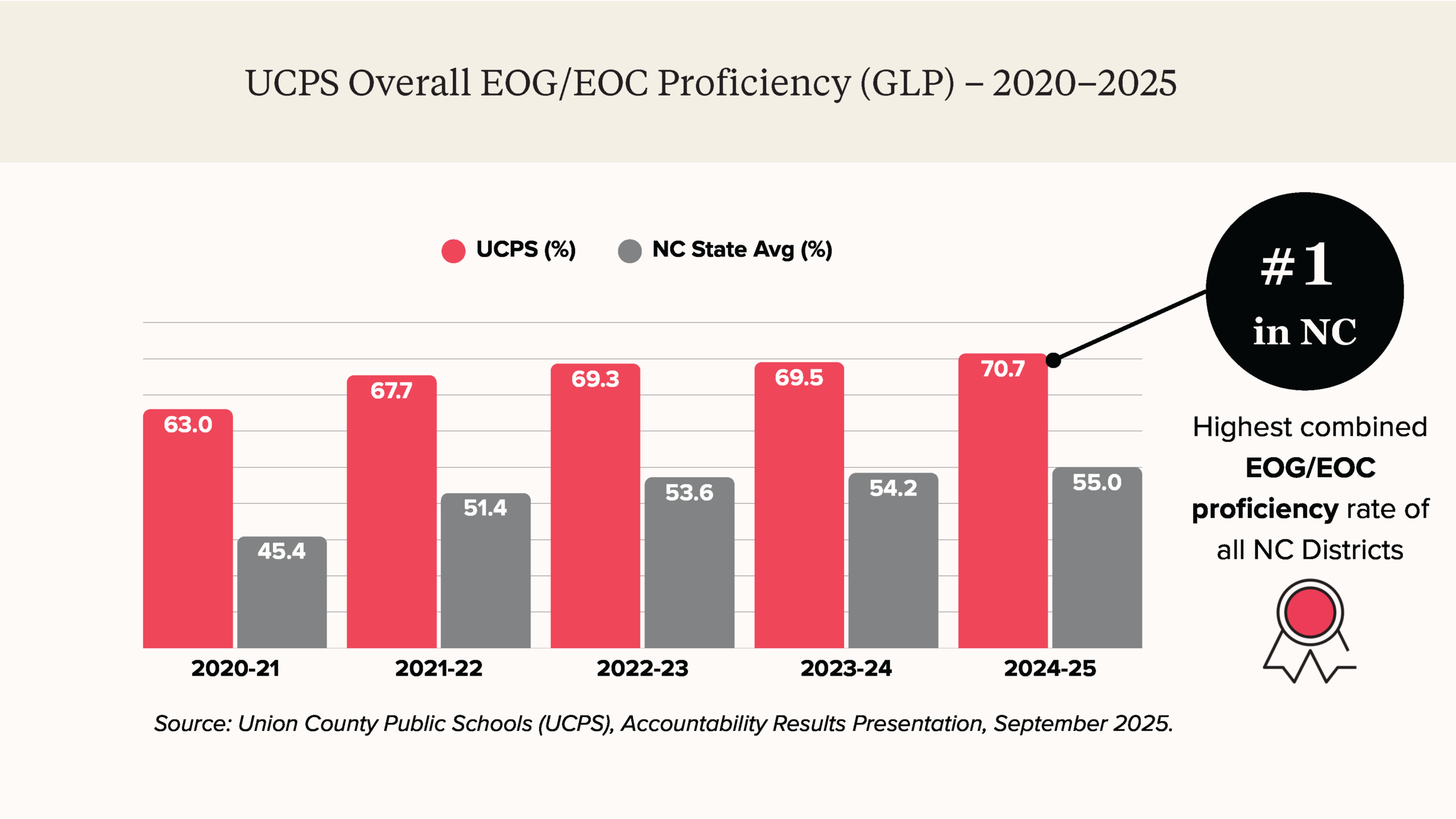
EOG/EOC (End-of-Grade/End-of-Course) tests in North Carolina measure student achievement, and GLP (Grade Level Proficiency) is a key performance benchmark, meaning a student scored a Level 3 or higher on these standardized tests, showing sufficient understanding of grade-level content and readiness for the next level.
Expanding the use of Renaissance throughout UCPS
By aligning educational tools with strong professional development, UCPS has proven that it’s possible to achieve exponential growth over the course of just several years. Now, more schools throughout the district are ready to get started.
“One of our high school principals said, ‘My son was talking to me about his goals in Freckle. Isn’t that a math program? How do I get that for my high school students?’” Rimmer said. “As a dad, he heard his middle school son articulate: ‘This is my score in Star Math, this is where I want to be, and this is what I’m going to do to get there.’ That’s powerful.”
So powerful, in fact, that the district has now adopted Star Math and Freckle across all nine of its middle schools and is doubling down on its commitment to math success by extending pilots into high schools. To be sure, these pilots are taking a page from Dr. Patience’s playbook, where strong professional development and clear expectations for utilizing data and practice are pivotal to implementation success.
Ready to make significant gains?
Improve math performance across your schools with tools that provide a powerful combination of reliable performance data and quality, adaptive practice for critical foundational skills. Learn more about how Renaissance tools, including Star and Freckle, work together to provide both.