
Federal funding for elementary and secondary schools

The Every Student Succeeds Act (ESSA) provides both formula funds and competitive grants. These federal funds provide billions of dollars for education programs each year that districts use to supplement state and local funding.

  • Formula funds are allocated annually to state education agencies or directly to school districts based on the number of students meeting specific eligibility criteria.
  • Competitive grants are awarded through a selection process. They are typically multi-year, and the dollar amounts are usually significant. The applications require compelling data to support the need, precise plans for the proposed program, and rigorous attention to detail.

Renaissance solutions qualify for purchase under a variety of federal K–12 education funding streams, as well as federal funding for preschool, to support student learning and growth in any environment.

Our Federal Funding for Elementary and Secondary Schools brochure provides a brief overview of each Renaissance solution and the individual funding streams to which they align, plus information on relevant professional learning to support effective implementation of each solution.

Download the brochure

The Renaissance ecosystem

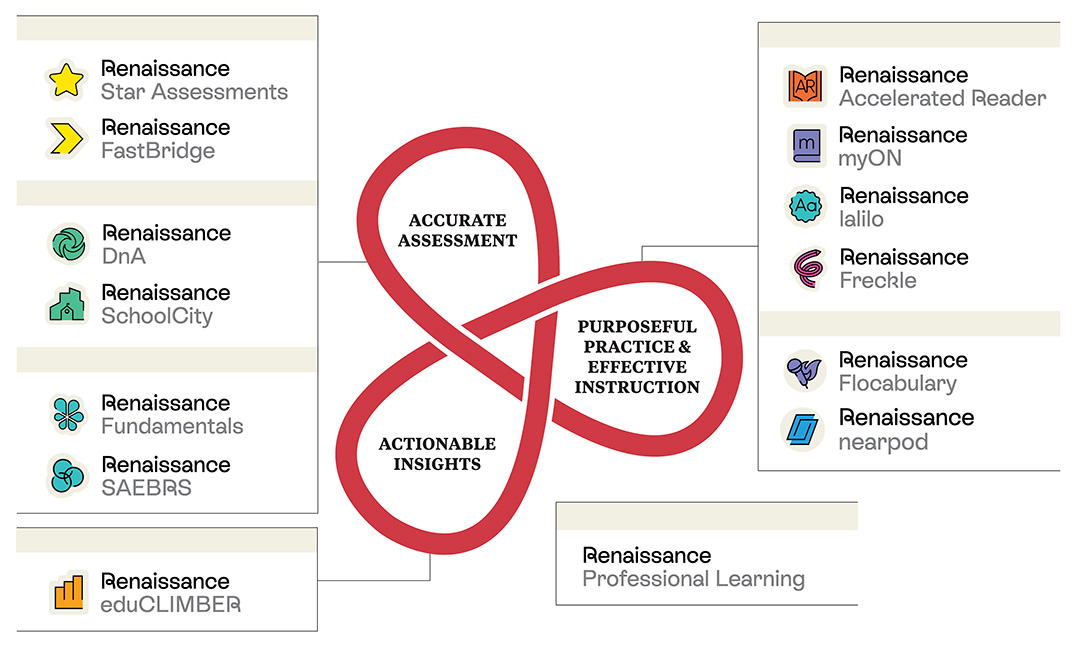
a diagram of the Renaissance Ecosystem with product alignments

The interconnected solutions within the Renaissance ecosystem accurately assess learning and growth, provide purposeful practice and effective instruction, and support a whole child approach to data-informed decisions.

Learn more about these solutions:

Federal Funding At-a-Glance

Check out our Federal Funding At-a-Glance matrix for a snapshot of solutions most closely aligned to each federal funding stream.

About Federal Formula Funds and Competitive Grants

Billions of dollars in formula funding and competitive grants are used each year to supplement state and local funding for education.

Formula Funds

Title I – Improving Education Programs for Disadvantaged Students

Title I is intended to help low-income students who are failing or at risk of failing to meet state academic achievement standards.

Title II – Supporting Effective Instruction

Title II provides funding for professional development, including an emphasis on enabling teachers to understand and use assessments and data to improve classroom practice and student learning.

Title III – Language Instruction for English Learners and Immigrant Students

Title III funding is used to enable students with limited English proficiency to master English and meet the same academic achievement standards as all children.

Title IV-A – Student Support and Academic Enrichment

Title IV-A is funding for student support and academic enrichment, including activities that support safe and healthy students and the effective use of technology to improve academic achievement and digital literacy.

Title V – State Innovation and Local Flexibility

Title V authorizes the Rural Education Achievement Program (REAP), which helps rural LEAs use other federal formula funds more effectively to address their unique needs.<

IDEA, Part B – Students with Learning Disabilities

IDEA, Part B enables Local Education Agencies (LEAs) to develop and implement coordinated early intervening services (CEIS), including MTSS frameworks, for students who are currently not identified as needing special education.

McKinney-Vento Homeless Assistance Act

McKinney-Vento Homeless Assistance Act guarantees educational rights for youth experiencing homelessness by ensuring they have access to the same public education as other students and are provided support to overcome related challenges.

Competitive Grants

Comprehensive Literacy State Development grants

Comprehensive Literacy State Development grants will provide 5 years of funding to improve student literacy in 23 states and the District of Columbia through subgrants to LEAs. The funding covers students from birth through grade 12, with an emphasis on disadvantaged children including those living in poverty, English learners, and children with disabilities.

Title IV-B – 21st Century Community Learning Centers

Title IV-B (Nita M. Lowey 21st Century Community Learning Centers) funding supports community learning centers that provide students with academic enrichment opportunities along with activities designed to complement the students’ regular academic programs. Title IV-B funding is allocated to states according to a formula; however, grant awards within each state are made on a competitive basis.

Head Start

Head Start programs help preschool-age children from low-income families prepare to succeed in school through screening, ongoing assessments, effective practices in language and literacy, and other developmental domains. Programs are delivered in a variety of settings, including public schools.

Preschool Development Grants

Preschool Development Grants support the strengthening of early care and education systems through initiatives that enhance high-quality early childhood experiences to prepare children from low-income families to be successful in school.

portrait of a group of diverse students

Comprehensive Literacy State Development Grants

The US Department of Education has awarded five-year Comprehensive Literacy State Development (CLSD) grants to 23 states and the District of Columbia. Learn more about these grants and how the Renaissance literacy portfolio of pre-K–12 solutions offers districts a comprehensive approach to meeting their state’s CLSD goals.

Other frequently-used funding options

Budgeted funds

Many of our customers use dollars already budgeted within their districts to purchase Renaissance solutions. These include allocations for assessments, instructional materials, library collections, technology, professional learning, and contributions by district foundations and parent organizations.

The best strategy for accessing these funds is to include the cost of your Renaissance programs when administrators prepare yearly budgets. If a formal proposal to an administrator is required, we can help.

Foundation and corporate funds

Foundation and corporate support for education is often focused on specific areas of interest, such as literacy, STEM, elementary education, or particular student populations.

Foundations may award grants nationwide, within a specific state, or only in designated regions or communities. Corporations usually offer grants in locations in which their employees or customers live or work.

Funding your summer learning program

Federal, state, and local funds can help you implement Renaissance solutions that boost learning during summer and throughout the school year.

Funding Resources Guide

Finding state and local opportunities—and writing an effective proposal for school funding—can be a challenge. Your Guide to Securing Funds to Accelerate Student Learning provides tips and resources on how best to approach funders and get the most from your efforts.

Download the guide

What you’ll find in the guide:

  • Preparing a proposal to your administration
  • Tips for making a phone call to a foundation
  • Tips for working with a grant writer
  • Writing successful foundation and corporate grant proposals
  • Finding funds in your own backyard
  • Grant-writing dictionary

Need assistance with federal, state, or local funding opportunities for your school or district?

Select your school

Searching for schools in ZIP code ---

Loading schools…

Don't see your school?